

Twin Sequin Embroidery: Combining Shapes and Layers
- Posted by Flavio Marini
What are sequins?
Sequins are small decorative elements stitched to a surface for shine, colour and movement. They may be made from different materials, including polyester. Recycled-content options also exist, but the material and percentage must be checked for the specific sequin. By varying size, shape, colour and stitch placement, a designer can create a repeated all-over surface or a more focused motif.
-
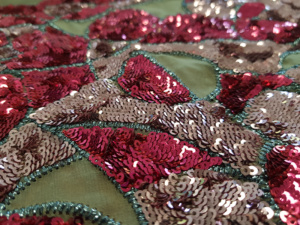
- All-over tulle sample using two metallic sequin types
-
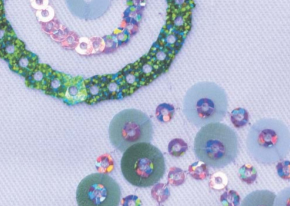
- Adjacent and overlapping sequins in varied sizes
-

- All-over twin-sequin embroidery using two sequin colours.
Combining sequin types in one design
The original article calls this approach “twin” sequin embroidery. It uses different sequins in the same design, for example a contrast of sizes or finishes, to create depth and a handcrafted look. Electronic embroidery equipment can repeat such a layout across a panel. The achievable speed and working area depend on the machine, base fabric and pattern; the 2019 article’s quoted 120 cm by 6 m field is a historical specification to confirm for a current order.
The Italian page contained a pasted block of rendered gallery HTML with internal staging links. The four sample strips are presented here as a normal WordPress gallery with English captions and working image links.
-

- Two different sequin types arranged in sequence.
-

- Two sequin types overlap slightly to create a scale effect.
-

- Sequins layered vertically in an embroidered pattern.
-

- Overlapping and adjacent sequins form a scale effect.
Fashion fabrics and accessories
Sequin embroidery can be used on clothing, footwear, bags and other leather goods, as well as on suitable fabrics such as tulle, organza or silk. Base material, stabilisation and sequin weight must be tested together. A dense application can cover a textile panel, while a smaller composition can become a patch or shaped embellishment.
-

- Mirrored sequins embroidered across a textile panel in varied placement.
-

- Decorative embroidery sample combining sequins and glass bugle beads.
-
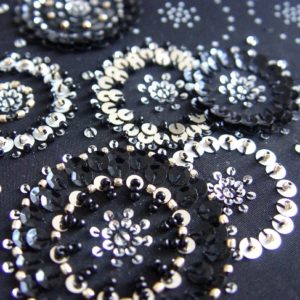
- Flower-shaped sequins combined with beads on a fabric base.
Custom sequin shapes and finishes
For a specific design, sequins may be selected from an available range or cut to a new shape from a suitable sheet material. Possible surfaces include metallic, printed or other decorative finishes. Laser cutting and digital printing may be considered where the material and production process allow them; the exact option is confirmed during sampling.
-

- Tulle embroidery with sequins and bugle beads.
-

- Wool embroidery combined with sequins applied by hand.
-

- Thread embroidery with hand-applied sequins and bugle beads.
Sizes and formats
The Italian article lists example diameters of 2, 3, 4, 4.8, 5, 6, 6.8, 7, 9, 11, 12, 14, 18, 21 and 23 mm. The historic list is a guide to potential scales, not a current stock catalogue. Shapes can be round, cupped, off-centre, floral, square, rectangular, oval, diamond, ring, triangular, star or drop shaped. Convex, hammered and reversible finishes are also mentioned. Availability and machine compatibility are checked for each project.

Mirrored metallic sequins across an all-over embroidered textile panel.
Explore the sample range
Our sample work includes all-over panels, patches and shaped embroideries. For related examples, see the guide to custom sequin fabrics and the article on recycled-PET sequin materials. To discuss a combination of sequins for your collection, contact Marini Ricami 1986.
0 comments on Twin Sequin Embroidery: Combining Shapes and Layers