
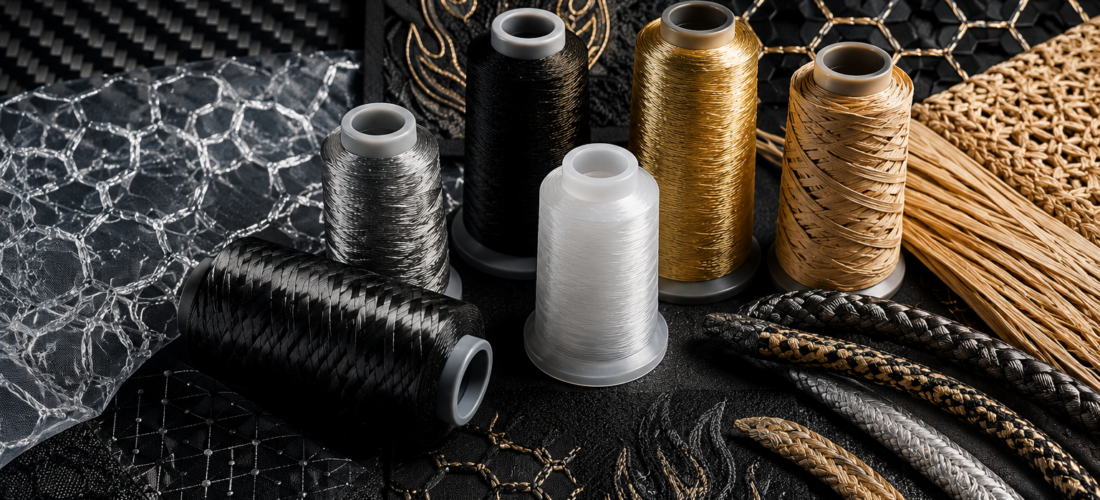
Technical Yarns for Industrial Embroidery: Carbon, Aramid, Raffia and Smart Textiles
- Posted by Flavio Marini
In modern industrial embroidery, yarn can do more than add decoration. Technical yarns can be selected for particular properties, including mechanical strength, heat behaviour, electrical conductivity, water solubility, low weight and distinctive textures.
For fashion, automotive, aerospace, marine and interior projects, these materials expand the possibilities of embroidered surfaces. The performance of a finished product depends on the exact yarn, construction and testing required for its intended use.
Carbon yarns: lightness, technology and performance
Carbon-based yarns can offer a technical appearance alongside properties such as low weight, mechanical strength, electrical conductivity and antistatic behaviour, depending on their composition and construction. Potential applications include automotive interiors, technical clothing, luxury-tech accessories, aerospace components, antistatic surfaces and sports products.
In industrial embroidery, carbon can create contemporary details for premium and performance-oriented designs. Selected conductive yarns may also suit ESD and antistatic projects after application-specific testing.
Read more about carbon-fibre embroidery and Tailored Fibre Placement (Italian).
Raffia yarns: a natural look and three-dimensional texture
Raffia’s natural-looking, tactile character makes it useful for luxury footwear, bags, leather goods, fashion accessories, hats, three-dimensional details and industrial interpretations of crochet or handwork.
The challenge is to retain its crafted appearance while controlling the stability and precision needed for repeatable production. Raffia embroidery can create natural-looking surfaces, volume, controlled irregularity and lightweight summer textures.
Read more about machine embroidery with raffia (Italian).
High-strength yarns for demanding applications
Some technical yarns are developed for high tensile strength, cut or abrasion resistance, low weight and mechanical stability. They may be considered for protective products, reinforcement, outdoor equipment, professional gear and other demanding industrial uses.
In embroidery, these materials can serve as a technical stitch or a functional decorative element. Their suitability must be assessed against the specifications of the finished product.
Aramid yarns for heat-resistant applications
Aramid fibres are used in applications where thermal and mechanical performance matter. Depending on the grade, they can offer heat resistance, tensile strength, chemical resistance and resistance to melting. Uses include protective clothing, technical automotive products, aerospace components, industrial filters and cut-resistant equipment.
These properties belong to specific fibres and constructions; any protective or fire-related claim for a finished article requires appropriate testing and certification.
Flame-resistant and self-extinguishing yarns
Specialist yarns can be selected for projects with flame-resistance requirements, including seating for vehicles and transport, aviation interiors, marine interiors, contract furnishings and technical clothing.
Depending on the material and treatment, relevant characteristics may include reduced flame spread, colour stability, durability and suitability for industrial processing. The finished embroidered assembly still needs to meet the applicable standards for its use.
Conductive yarns and smart textiles
Conductive yarns can add antistatic properties, transmit signals or connect textile surfaces to sensors. They open possibilities for smart fabrics, automotive interiors, interactive fashion, wearable devices and integrated lighting.
What a particular embroidery can do depends on its yarn, stitch pattern, connections and testing.
Read more about embroidery with conductive thread (Italian).
Water-soluble yarns: a thread designed to disappear
Water-soluble yarns can provide temporary support during embroidery and then dissolve during finishing. They are used in processes for removable structures, lace, openwork and suspended or three-dimensional effects.
The result depends on the embroidery design, the other materials and the washing process. These methods support lightweight fashion surfaces and intricate decorative details.
Materials shape the future of industrial embroidery
By combining yarn selection with embroidery design, teams can explore mechanical properties, technical functions, responsible material choices and new visual effects. Understanding each material helps designers and R&D teams turn a concept into a feasible product.
Contact Marini Ricami 1986 to discuss materials, samples and a custom embroidery project.
0 comments on Technical Yarns for Industrial Embroidery: Carbon, Aramid, Raffia and Smart Textiles