
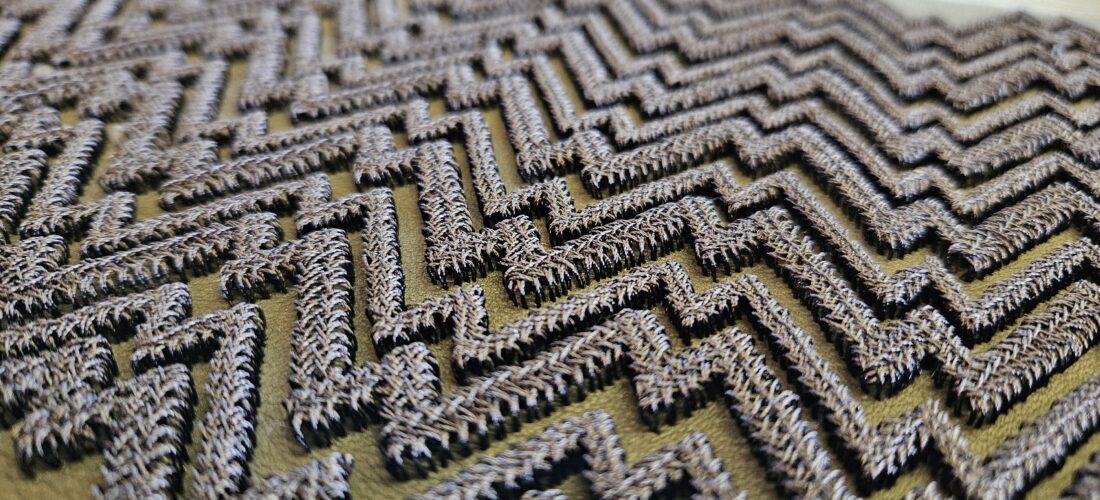
Soft 3D Embroidery on Leather and Fabrics
- Posted by Flavio Marini
Three-dimensional embroidery gives a stitched motif visible and tactile volume. A conventional way to build this effect is to place a foam or other padding material under the stitches; the remaining support may then need trimming by hand. The Italian article describes a softer raised effect developed through work on stitch parameters, yarns and a temporary support. It presents examples on fabrics and genuine leather. The finish must be assessed on the actual base material: no embroidery method can guarantee the same result on every fabric or leather.
Developing soft, flexible raised embroidery
For the method described in the source article, a temporary support holds the stitches as yarns are layered to create height. The support is then removed after embroidery, so the raised motif can feel softer than a design built around permanent foam. The quality of that removal depends on the backing, yarn, stitch density and finishing process. A sample is the right way to check both the front and reverse of the motif before production.
Our development work focuses on how support materials and embroidery settings affect the finished texture. The aim is a dimensional design that retains a pleasant hand and the detail of the selected threads. How much relief can be achieved, and whether any support remains visible, should be checked for each design and material rather than assumed in advance.
Raised embroidery on leather requires care
Genuine leather can be a demanding embroidery base. Needle holes are permanent, and unsuitable backing or finishing can stiffen, mark or distort the surface. The Italian article shows how a soft 3D motif can be explored on leather using temporary support. In practice, the leather type, thickness, coating, colour and construction need to be tested together with the thread and stitch programme.
A raised logo, monogram or ornament may add tactile detail to a bag, jacket, shoe or hat. The approved prototype should show how the motif follows the leather as it bends and whether the colour and surface finish remain acceptable. Even a successful sample does not remove all material limits: stitching always changes the base where the needle passes through it.
Creative applications: clothing and accessories
The source article imagines summer leather footwear with raised raffia-effect details. It also describes several ways to develop soft dimensional embroidery for fashion products:
- Bags and small leather goods: floral relief on leather bags, fabric backpacks, clutch bags or wallets. Raffia-effect yarn and other textured threads can lend a craft-inspired look, subject to sampling for flexibility and wear.
- Footwear: decorative motifs on shoe uppers and sneakers. Sandals or espadrille-style shoes can use a raised zigzag blanket-stitch border, while logos or lettering can be considered for textile trainers and boots. Comfort and durability must be checked on the finished shoe.
- Hats and accessories: raised logos on caps, tactile motifs on textile or straw hats, and custom monograms on belts, bracelets or decorative cushion covers.
- Clothing and couture: layered motifs on jackets, dresses, denim, leather or synthetic-leather garments. The yarn, base fabric and placement determine whether the added volume remains suitable for the garment’s movement and care.
Yarn choice is central to each of these ideas. Alongside conventional embroidery threads, a design may use viscose raffia-effect yarn, cords, chenille or tape to create different levels of texture and sheen. Viscose is a regenerated cellulose fibre, but its composition alone does not establish that a yarn or finished item is certified, biodegradable or environmentally preferable. Such claims need current documentation for the specific material and product.
Technical and design considerations
- Softness and comfort: an approach without permanent foam can produce a more yielding motif. Hand feel and skin contact should be checked on a finished sample, especially for garments and accessories worn against the body.
- Respect for the base material: temporary support can reduce unwanted stiffness, but leather and fabric still react to needle penetration, tension and finishing. Verify flexibility, colour and surface appearance on the selected material.
- Design freedom: fine lines, larger areas and intricate patterns can be explored by adjusting support, stitch density and yarn. Their feasibility and definition depend on the approved prototype.
- Material range: cotton, polyester, denim, genuine leather and other bases call for different settings. A successful result on one surface does not guarantee the same effect on another.
- Craft-inspired appearance and repeatable placement: programmed embroidery can reproduce an approved raised motif across a production run while giving it a hand-finished visual character. Consistency still relies on material quality and process control.
Innovation in the service of design
Soft 3D embroidery expands the visual possibilities of fabrics and selected leathers: a raised logo on a sneaker, a textured motif on a couture garment or a decorative detail on a summer hat can all begin with the same question—how should the surface look and feel in use? We develop the stitch programme and material combination through sampling, then assess the result before specifying production. For a related overview, see our soft raised embroidery examples. Contact us to discuss a design brief.
0 comments on Soft 3D Embroidery on Leather and Fabrics