
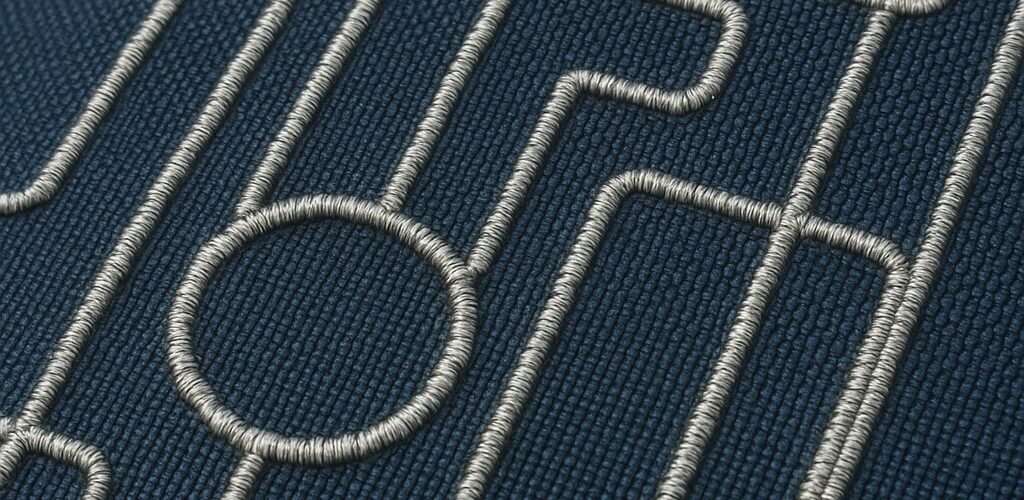
Smart Yarns from Marini Ricami’s Research and Development Lab
- Posted by Flavio Marini
Functional yarns can make embroidery part of a wider textile-technology project. Marini Ricami’s research and development lab has developed four functional-yarn directions—conductive, metallic, composite-compatible and responsive yarns—and describes possible uses in fashion, vehicles, interiors, aerospace and healthcare. The resulting materials open opportunities for fashion and technical textiles. Specifications and qualification depend on the final product and intended use.
1. Silver-coated conductive yarns
A silver-coated yarn can be used to explore stitched electrical paths. The team works with two variants: one for simple circuits or sensors and one with a more fully conductive surface for textile electrodes or touch interfaces. The composition, resistance, skin-contact suitability and durability depend on the exact yarn and construction.
- Fashion technology: a garment or accessory concept with a touch-responsive detail.
- Automotive interiors: a textile interface concept, subject to vehicle-system and safety validation.
- Healthcare research: textile electrodes for cardiac or physiotherapy concepts; finished medical products require the applicable electrical, biological and clinical validation.
- Aerospace research: sensor-integrated textiles that require sector-specific qualification before use.
2. Metallic yarns for RFID and heating concepts
Conductive yarns can form components in an embroidered RFID antenna or a resistive heating design. Tracking garments through a supply chain, monitoring professional laundering, adjustable warmth in an outdoor jacket and heated seating are examples to explore. An actual system would need a defined circuit, power supply, protection, test method and approval for its intended use. An embroidered thread alone does not deliver these functions.

Illustrative colour-changing yarn example; response temperature and durability require product-specific testing
3. Yarns for composite-material research
Marini Ricami has developed a treated yarn intended for compatibility with epoxy and thermoset resins. Composition, adhesion and mechanical behaviour are evaluated for the chosen composite process. Potential research settings include lightweight automotive components, marine interiors, aerospace panels and technical furniture. A decorative stitched sample does not by itself establish structural performance.
4. Responsive and indicator yarns
Some textile materials are designed to respond to heat, ultraviolet light, moisture or other stimuli, while others can form part of a sensor assembly. Development concepts include sportswear that signals a condition, garments with colour-changing details, moisture indicators in seating and healthcare patches. Each final use requires a defined sensing method, signal interpretation, safety and care specification. A colour change must not be treated as a medical measurement without evidence.
Why these directions matter
Functional embroidery could combine decorative design with sensing, signalling or electrical connections. It might reduce separate rigid components in a particular product, but that benefit and any environmental advantage require comparison with a complete tested design. Washability, weight and material sourcing cannot be assumed across different yarns.
Conductive, heating, tracking, sensing and colour-changing yarns are part of Marini Ricami’s research and development work. Contact us about a specific development brief and ask which current materials, samples and test reports are available.
0 comments on Smart Yarns from Marini Ricami’s Research and Development Lab