
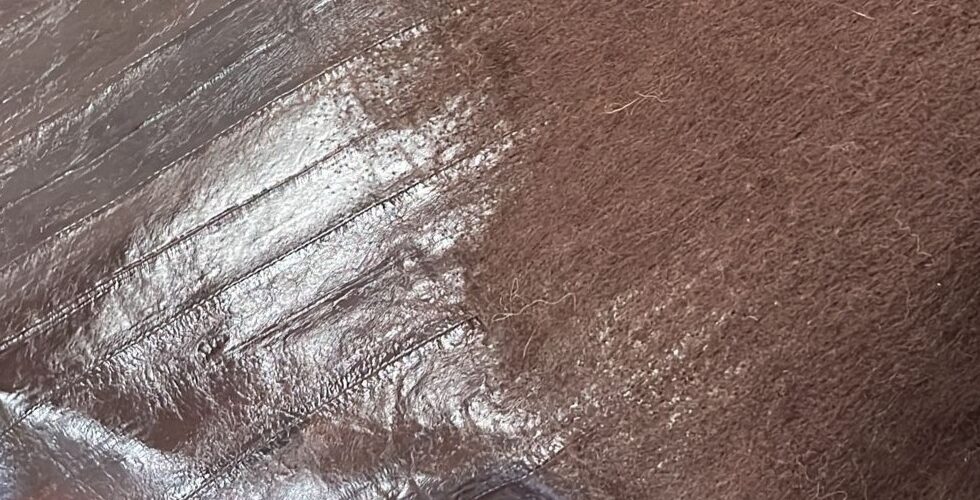
Needle Felting on Genuine Leather: Where Materials Merge
- Posted by Flavio Marini
The possibility of joining two very different materials—full-grain leather and textile fibres—without visible stitching, adhesives or heat bonding is now a practical production technique. Known as needle felting on genuine leather, it is an area in which Marini Ricami 1986 has invested in research, machinery and technical development to offer an industrial service for other brands.
What is needle felting on genuine leather?
Needle felting, also called needling, is a dry mechanical felting process. Barbed needles with tiny notches along their shafts penetrate a layer of loose fibres—wool, cashmere, silk, alpaca, mohair or blends—and, through thousands of movements per minute, mechanically entangle the fibres with one another and with the supporting material.
The principle is entirely mechanical: no glue, sewing thread or heat. The bond between fibre and support is formed by the action of the needles themselves, one penetration after another.
The technique has been used on textiles in industrial embroidery for decades. Applying it to tanned genuine leather—nappa, calfskin, lambskin, goatskin, full-grain leather or nubuck—is considerably more complex. Leather does not behave like woven fabric: every processing parameter must be calibrated to avoid tearing the surface grain, weakening the material or changing the feel of the finished leather.
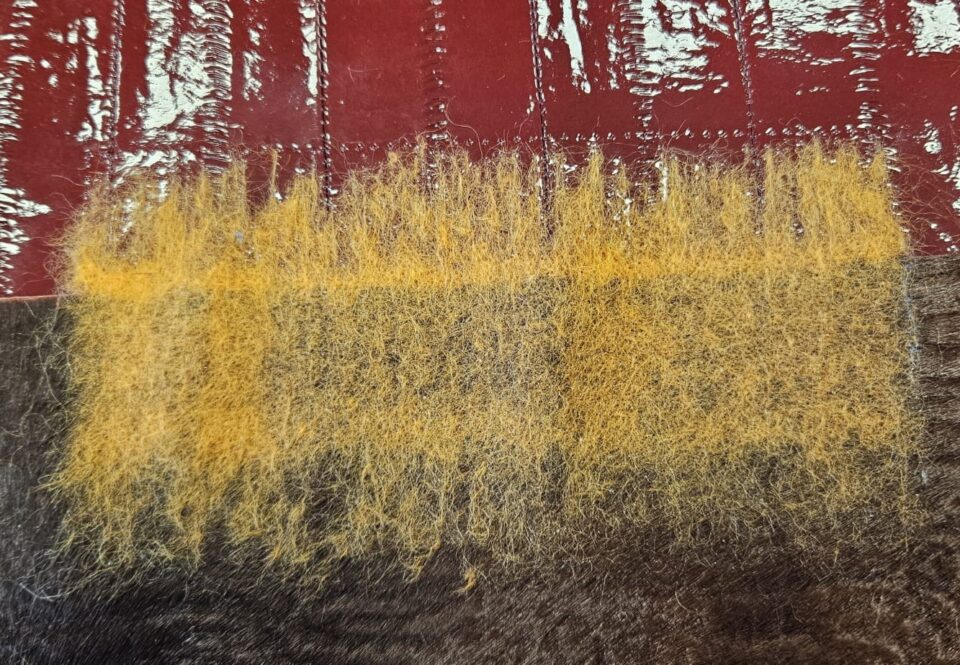
Needle felting used to join two types of leather
What it creates: materials that merge
The effect that sets needle-felted embroidery on leather apart from other decoration and application techniques is the way the materials merge. The fibre is not simply placed on top of the leather; it is worked into its surface layers.
Visually, the transition between the two materials has no sharp edge. It becomes difficult to see exactly where the fibre begins and the leather ends, much like a photographic fade. Stitching, heat-bonded films and conventional appliqué create a different kind of join.
From a production perspective, the variables that can be controlled include:
- Needle density — determines how compact the resulting felt becomes.
- Penetration depth — controls how far the fibres are worked into the leather surface.
- Stroke speed — affects mechanical cohesion and the appearance of the surface.
- Fibre type and weight — coarse wool creates a more sculptural effect, while cashmere or silk can produce finer, more luminous transitions.
- Leather thickness and type — each leather responds differently to repeated needle penetration.
The boundary between a gradual fade and a defined edge, a flat field of colour and a three-dimensional texture, or a treated area and bare leather can be established during programming. The process draws on craft knowledge, but its parameters are tailored and repeatable for each project.
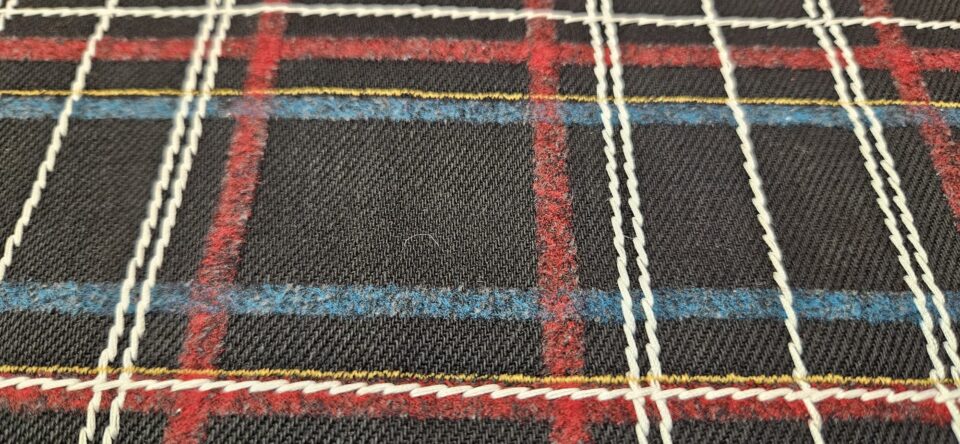
Needle-felted denim with a tartan motif and quilting
Why it matters to fashion houses and luxury leather goods
Luxury fashion has long explored the deconstruction of materials as a design approach. Unfamiliar surfaces, seemingly impossible material combinations and components that reveal a sophisticated production process help brands create distinctive products.
Needle felting on leather offers possibilities across several product categories:
Clothing and outerwear
Jackets, coats and blousons can appear to fade from one material into another without a visible seam. A leather-to-wool or leather-to-cashmere transition becomes a design feature in its own right rather than merely a construction detail.
Leather goods: bags, wallets and accessories
Felted natural-fibre inserts can add visual and tactile warmth to a structurally firm leather surface. Needle felting for leather goods can personalise selected areas of an accessory with colour and texture that differ from conventional embroidery.
Footwear
Soft materials are normally integrated into quarters, tongues, boot collars and uppers by stitching or gluing. Needle felting offers a third approach—a mechanical bond—with a distinctive surface finish.
Samples and collection development
The technique lends itself to prototyping. A single component can be developed, assessed and approved before the process is scaled for a production run. This gives design teams room to experiment without committing to large quantities at the outset.
How our manufacturing service works
Marini Ricami manages the technical process from material analysis and machine set-up through validation sampling, series production and quality control. We work with the discretion fashion houses expect. We do not make finished garments or market products under our own brand: we are a specialist manufacturing partner, and confidentiality is part of our service.
With nearly forty years of experience in industrial embroidery on leather and textiles, we can handle both individual samples and larger production programmes while applying the same care to technical parameters.
The materials we commonly work with include bovine and lamb nappa, smooth calfskin, goatskin, lambskin, full-grain leather and nubuck. Possible fibres include merino wool, cashmere, mohair, alpaca, spun silk, wool–silk blends and technical yarns specified by the client.
Looking for technical advice?
We work with design studios, product managers and purchasing teams at Italian, French, British and Spanish fashion houses. If you need a technical partner for contract needle felting on genuine leather, contact us.
0 comments on Needle Felting on Genuine Leather: Where Materials Merge