

Embroidered Seat Covers for Transport Interiors
- Posted by Flavio Marini
Seat covers for public and private transport must combine a suitable surface finish with the comfort and durability required by the vehicle. Marini Ricami 1986 works with embroidery, decorative stitching, quilting and perforation for transport-interior projects. The material, construction, regulatory requirements and production volume should be defined for each brief.
Applications in public and private transport
The techniques described here can be considered for buses, school buses, trains, ships, cars and special projects. Each setting has different requirements for wear, cleaning and safety. Samples should be assessed against the specifications of the relevant vehicle or operator.

Passenger seat cover sample with a hexagonal quilted pattern.
Perforation sizes listed in the original article
Round holes: 0.8, 0.9, 1.0, 1.1, 1.2, 1.3, 1.4, 1.5, 1.7, 1.8, 2.0 and 2.5 mm in diameter.
Square and diamond holes: 1.5 × 1.5 mm.
Triangular holes: a punch with a 1.7 mm side is described.
These dimensions are those published in the Italian article. Current tooling, tolerance, substrate compatibility and availability must be confirmed for a new project. A perforation pattern should also be checked for its effect on the complete cover and seat assembly.
Custom embroidery and perforation
Automated equipment can produce geometric stitching and repeated decorative motifs. Embroidery and perforation can be combined to develop a surface tailored to the vehicle interior. The final result depends on the chosen material, padding, pattern and finishing process; prototypes allow the appearance and function to be reviewed before a production run.
-
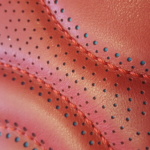
- Perforated and stitched leather sample
-

- Vehicle seat-back sample with decorative embroidery and perforation
Production planning and flexibility
The Italian article describes both larger runs and small customised batches. Capacity and delivery times are project-specific and should be confirmed against the current production schedule, material availability and approved sample. For larger programmes, repeatability and quality checks should be agreed before launch.
Quality and compliance
The original article mentions ISO 9001, but a current certificate and its scope should be checked before making a certification claim for a particular contract. A quality-management standard does not by itself certify a finished seat cover against transport safety, fire or environmental rules. Those requirements need to be identified and documented separately for the destination market and vehicle.
Materials and environmental considerations
Lightweight or recycled-content materials may be considered where suitable. Any environmental claim needs evidence for the specific material and complete product. Working through samples can help balance visual design, durability, maintenance and material use.
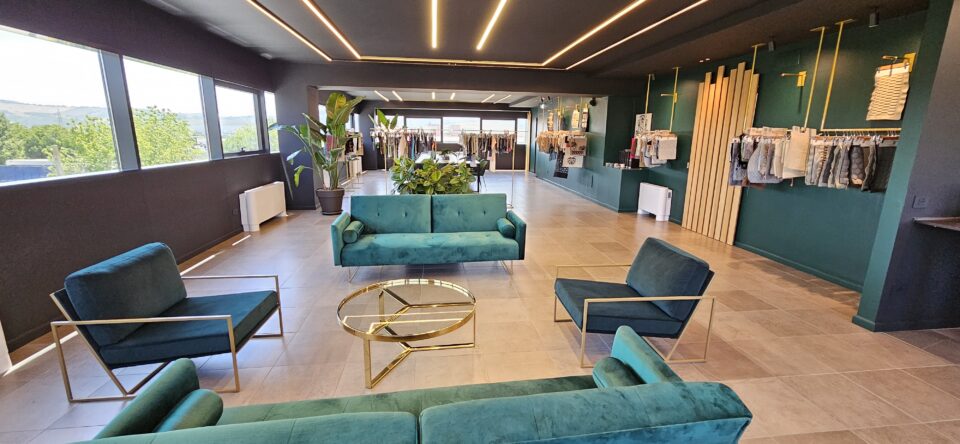
Marini Ricami showroom and sample collection.
We can show samples and discuss a collaboration at our premises in Mosciano Sant’Angelo (TE), near the Giulianova-Mosciano exit of the A14 motorway, or arrange a meeting around a project brief. Contact us in English or call +39 085 8002926 to discuss materials, quantities and requirements.
0 comments on Embroidered Seat Covers for Transport Interiors