

Embroidered Flowers and Petals: Three-Dimensional Design
- Posted by Flavio Marini
Three-dimensional solutions in materials, technique and design
In advanced industrial embroidery, embroidered flowers and petals are no longer merely decorative motifs. They can become components of the product itself. Petals, leaves, feathers and other organic forms are developed as three-dimensional elements for fashion, accessories, footwear and interior design.
At Marini Ricami we distinguish two broad groups of techniques, both supported by technical research and repeatable industrial production.
Thermoformed flowers, petals and leaves in leather and fabric
The first group consists of three-dimensional flowers and petals made as applied elements. They are produced from leather or fabric and subsequently assembled onto the finished product.
Production process
Leather or fabric petals follow a defined production sequence:
- Embroidery on the base material, whether genuine leather, synthetic leather, technical fabric or fashion fabric;
- Precision laser cutting to define the petal’s outline;
- Technical bonding of multiple layers to provide body and stability;
- Thermoforming with dedicated moulds to create volume and curvature;
- Where required, insertion of an internal metal support to shape complex, dynamic forms.
The metal support allows a petal to be bent, oriented, opened or closed while retaining the intended shape over time.
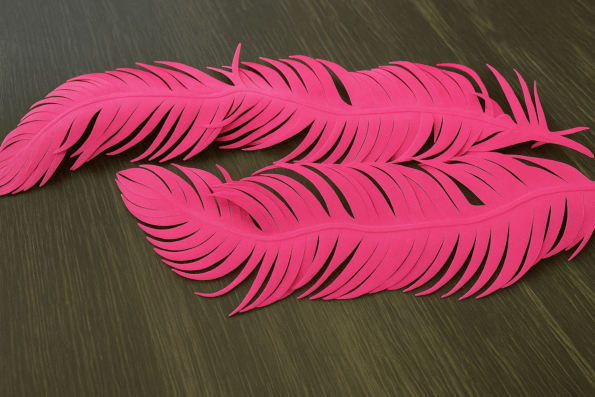
Pink three-dimensional decorative elements.
Suitable materials
- Genuine leather;
- synthetic leather;
- synthetic and natural fabrics;
- bonded fabrics;
- thermoformable technical base materials.
Technical advantages
- High dimensional stability;
- precise control over the shape;
- repeatable industrial production;
- the possibility of bold, sculptural volumes.
Main applications
- Fashion and couture footwear;
- leather goods, including bags, clutches and accessories;
- haute couture clothing;
- removable or modular decorations.
This approach is ideal when the flower becomes an object in its own right, not simply an ornament.
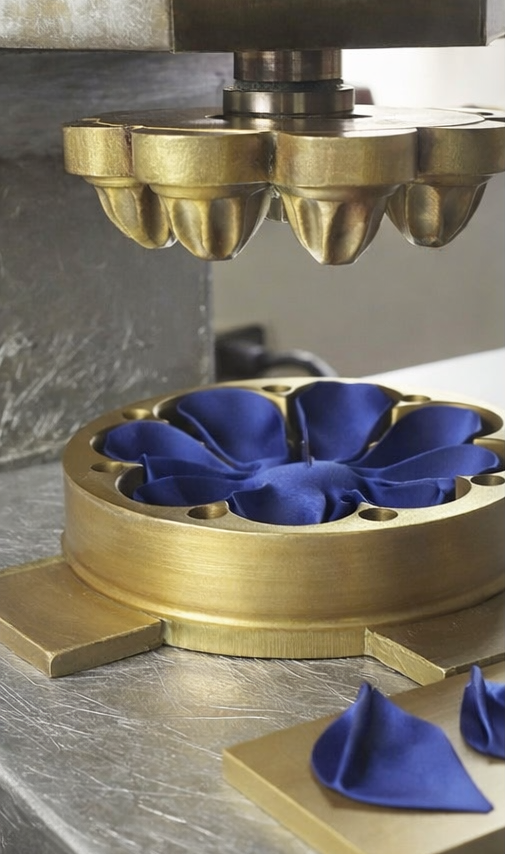
Petals shaped in a press.
Flowers and petals embroidered directly onto the base material
The second group consists of embroidered flowers whose volume is created by the embroidery itself, as shown in the examples. Here embroidery does not imitate a flower: it constructs one.
How the technique works
Embroidered flowers and petals can be developed through:
- High-density embroidery with different stitch directions;
- integrated three-dimensional elements;
- thermoforming after embroidery; or
- invisible metal supports incorporated within the embroidery.
The resulting flower rises from the fabric, with petals, leaves or feathers that have thickness, movement and depth.
Yarns and materials
- Cotton;
- wool;
- natural raffia;
- synthetic yarns;
- technical yarns.
The work can also be enriched with sequins, rhinestones, studs, and metal or plastic elements.
Creative possibilities
- Combining several materials in one flower;
- contrasting matte and glossy surfaces;
- naturalistic or graphic effects;
- mixing flat flowers with three-dimensional components.
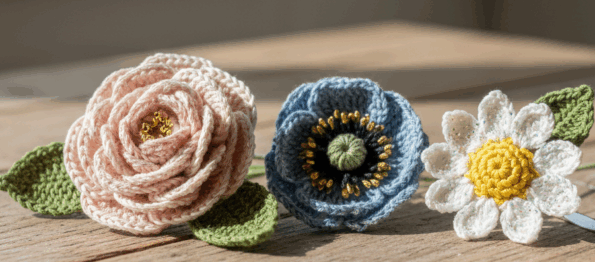
Crochet-style embroidered flowers.
Main applications
- Fashion and couture clothing;
- embroidery on raffia and natural materials;
- textile accessories;
- decorative details for special capsule collections;
- interiors and decorative textile panels.
In this case, the flower is a structural part of the embroidery, not an applied element.
Flowers, petals, leaves and organic forms: one design language
Whether the design uses petals, flowers, leaves, feathers or three-dimensional organic forms, the underlying aim is the same: turn a creative idea into a practical industrial solution while retaining a craft-inspired appearance and high quality standards.
Embroidered flowers and petals are an especially interesting area of advanced industrial embroidery. At Marini Ricami, each project starts with custom research based on references, images or a design studio’s concept. We adapt the proposed solution to the chosen materials, production volumes, technical constraints and manufacturing costs.
If you are developing a collection or a special project, contact us. We can develop embroidered flowers, petals and three-dimensional forms from scratch or draw on our archive for inspiration.
0 comments on Embroidered Flowers and Petals: Three-Dimensional Design