
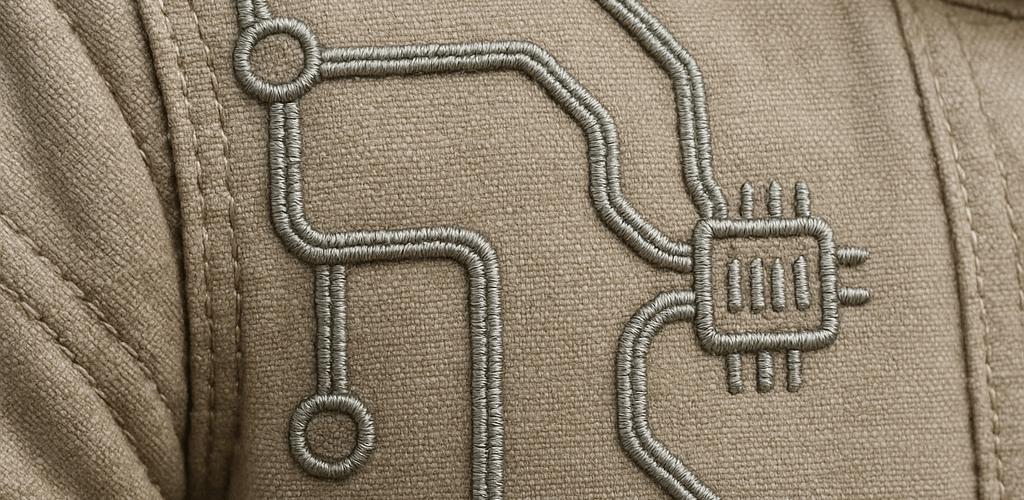
Conductive-Thread Embroidery: Textile Design and Electronics
- Posted by Flavio Marini
Conductive thread can bring an electrical path into an embroidered surface. Such a yarn may have a polymer core, for example polyamide or polyester, with a conductive metal coating such as silver. Its appearance can be integrated into a decorative pattern, but electrical behaviour depends on the exact yarn, stitch geometry, contacts and base material. Marini Ricami develops custom conductive-embroidery solutions from prototype to production, with validation matched to the intended use.
Technical properties to specify
| Property | What must be checked |
|---|---|
| Composition | Core fibre, coating metal, coating thickness and supplier declaration for the selected yarn. |
| Electrical resistance | For the selected yarns described by Marini Ricami, typical resistance is 100–600 Ω/m; a suitable conductive bobbin thread can reduce resistance by up to 90%. Values depend on the specific yarn, stitching and measurement conditions. |
| Flexibility | Performance after bending on the intended lightweight or technical textile. |
| Washing | Selected constructions withstand gentle washing at 30 °C while maintaining electrical function; the finished assembly needs a defined wash test. |
| Electrical safety | The applications discussed here use low voltage, up to 9 V. Safety depends on the complete circuit, power source, insulation and environment. |
Potential application areas
- Fashion and interactive clothing: stitched connections could be explored for LEDs, touch inputs, responsive patches or integrated circuits. A wearable product must be tested for comfort, durability and electrical safety.
- Automotive and transport interiors: capacitive controls, heating or lighting connections are design concepts. Vehicle use requires qualification of the whole textile-electronic system.
- Aerospace interiors: lightweight stitched conductors might be researched for certain cabin components; they cannot be described as a replacement for certified wiring without engineering and regulatory evidence.
- Healthcare and sport: textile ECG or EMG electrodes and physiological-monitoring garments are possible research fields. Medical-device use requires testing and the relevant approvals for the final product.
- Industrial, marine and interior systems: shielding, RF, antenna, heating and hidden connection ideas each require separate electrical and environmental validation.
Combining function and design
Unlike a separate visible wire, a conductive yarn can follow a stitched motif and become part of the visual design. Stitch density and type may change the electrical path, but the effect must be measured. Connections, insulation, laundering and repeated flexing can determine whether a concept works outside the laboratory.
Marini Ricami offers custom conductive-thread embroidery from prototyping to series production. The team selects yarns and test requirements for the specific brief. Contact us to discuss a specific concept and what technical validation it would require.
0 comments on Conductive-Thread Embroidery: Textile Design and Electronics